





Ion Exchange Resin Solution for PFAS Removal to Non-Detect Levels
PFAS contamination has become one of the most challenging issues in modern water treatment.
PFAS, or per- and polyfluoroalkyl substances, are a group of highly stable synthetic chemicals widely used in products and industrial processes that require water resistance, oil resistance, heat resistance, and chemical durability. Because of their strong carbon-fluorine bonds, PFAS are extremely difficult to degrade naturally and are often referred to as “forever chemicals.”
Once released into the environment, PFAS can persist in water, soil, and biological systems for a long time. Their presence in drinking water sources has created growing concern for utilities, industrial water users, and environmental treatment companies.
The key challenge is clear: PFAS are often present at trace levels, but must be removed to extremely low concentrations. Conventional water treatment technologies are often not enough.
Why PFAS Treatment Is Difficult
PFAS removal is technically challenging because different PFAS compounds behave differently in water.
Long-chain PFAS compounds such as PFOA and PFOS can be removed by some conventional adsorption technologies under certain conditions. However, short-chain PFAS compounds are generally more mobile, more difficult to adsorb, and less effectively removed by traditional treatment processes.
Common PFAS treatment technologies each have limitations.
Granular activated carbon can be effective for some long-chain PFAS, but its adsorption performance for short-chain PFAS is usually weaker.
Reverse osmosis can remove various contaminants, but its PFAS removal performance may vary depending on PFAS structure, membrane condition, and operating parameters. Membrane fouling and high operating cost can also become challenges.
Advanced oxidation technologies may theoretically break carbon-fluorine bonds, but practical operation can involve high cost and unstable treatment efficiency.
As PFAS regulations and customer expectations become more demanding, water treatment systems need technologies that offer higher selectivity, higher capacity, faster adsorption kinetics, and more reliable performance under real operating conditions.
This is where ion exchange resin technology becomes highly valuable.
Sunresin SEPLITE® LSI 106G for PFAS Removal
Sunresin developed SEPLITE® LSI 106G, a gel-type strong base anion exchange resin designed for PFAS removal in drinking water applications, including PFOA and PFOS removal.
The resin combines a stable matrix structure with specialized functional groups, giving it strong selectivity toward target PFAS contaminants. Its gel-type structure provides high treatment capacity, good mechanical stability, and reliable pressure resistance.
Under high linear velocity operating conditions, SEPLITE® LSI 106G can reduce PFAS in water to non-detect levels, supporting advanced treatment requirements for drinking water and other sensitive water applications.
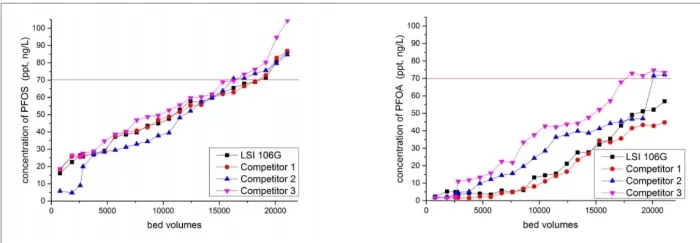
Comparison test of adsorption performance between LSI 106G and several competing products (inlet water concentration 10 μg/L, flow rate 20 BV/h)
The resin is designed to address several major challenges in PFAS treatment:
- High selectivity toward PFAS
- Effective removal of PFOA and PFOS
- Strong performance for short-chain PFAS
- Fast adsorption kinetics
- High treatment throughput
- Stable operation under high flow conditions
- Mechanical stability for engineering systems
- Regenerable process potential
Application Validation and Performance
SEPLITE® LSI 106G has been validated in multiple pilot projects and has achieved large-scale supply to overseas drinking water markets.
Practical application results show that the resin can meet on-site PFAS removal requirements and deliver performance comparable with international products in similar applications.
Sunresin also carried out systematic comparative studies on trace PFAS removal, including evaluation of ion exchange resin and granular activated carbon performance for perfluorosulfonic acid compounds with different chain lengths.
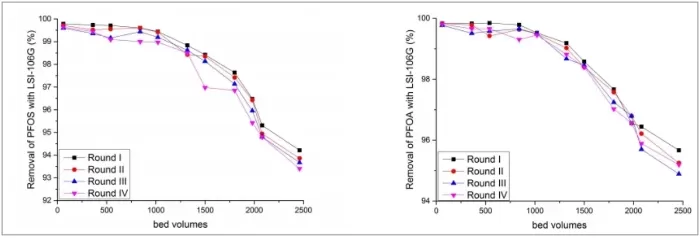
The adsorption performance after regeneration (with influent concentration of 50 μg/L and flow rate of 20 BV/h)
Using HPLC-MS/MS detection methods, trace PFAS in water can be accurately quantified, with detection precision meeting relevant standard limit requirements.
In comparative tests, ion exchange resin showed significant advantages over granular activated carbon.
The treatment capacity of ion exchange resin can reach 6–8 times that of activated carbon under tested conditions. The treatment precision is also significantly better, enabling PFAS removal to non-detect levels.
For regeneration, a 2–8% sodium chloride alcohol solution can provide optimal desorption performance, with PFAS desorption efficiency reaching 100% under tested conditions.
The operating flow rate is another important advantage. Granular activated carbon is generally suitable for operation at no more than 5 BV/h, while SEPLITE® LSI 106G can maintain efficient and high-precision PFAS removal at high linear velocities of 20–40 BV/h.
This makes the resin more suitable for large-scale water supply systems and engineering applications where high throughput and stable effluent quality are required.
Advantages of Ion Exchange Resin for PFAS Treatment
Compared with traditional treatment methods, SEPLITE® LSI 106G provides several important advantages in PFAS removal applications.
Better Performance for Short-Chain PFAS
Short-chain PFAS are often more difficult to remove with activated carbon. SEPLITE® LSI 106G shows stronger removal capability for short-chain PFAS, helping address one of the most difficult challenges in PFAS treatment.
High Adsorption Rate and Large Treatment Throughput
The resin offers fast adsorption kinetics and can operate under higher flow conditions. This supports compact system design and higher treatment efficiency, especially for large-scale water treatment projects.
Stable Removal to Non-Detect Levels
In tested applications, SEPLITE® LSI 106G can reduce PFAS to non-detect levels, supporting strict water quality requirements and advanced drinking water treatment needs.
Regeneration Potential
The resin can be regenerated using a sodium chloride alcohol solution under suitable process conditions, with high desorption efficiency demonstrated in testing. This provides a potential route for improving long-term operational economics.
Suitable for Engineering Applications
With good mechanical stability, pressure resistance, and high-flow operating capability, SEPLITE® LSI 106G is suitable for continuous or batch water treatment systems.
From Pilot Validation to Scalable Supply
PFAS treatment is not only a laboratory challenge. It requires stable product supply, engineering adaptability, and practical performance under real operating conditions.
Sunresin has achieved scaled production and supply of PFAS removal resin, supporting diverse application scenarios in drinking water treatment and environmental remediation.
From an engineering perspective, the key value of SEPLITE® LSI 106G lies in its ability to combine high selectivity, fast kinetics, high throughput, and stable effluent quality.
For water treatment operators, these advantages can help improve system reliability, reduce footprint pressure, and support long-term PFAS control.
Broader Water Safety Solutions from Sunresin
PFAS is only one part of the global water safety challenge.
Heavy metals, nitrate, boron, chlorate, organic pollutants, and other contaminants also require targeted treatment technologies. Different water quality problems require different resin structures, functional groups, and process designs.
Sunresin provides a broad portfolio of adsorption and ion exchange resin solutions for drinking water purification, industrial wastewater treatment, water reuse, and resource recovery.
Through advanced adsorption and separation materials, Sunresin supports customers in removing harmful contaminants while improving water treatment efficiency and environmental performance.
Supporting Cleaner and Safer Water
PFAS contamination is invisible, persistent, and difficult to remove. But with the right ion exchange resin technology, trace PFAS can be captured efficiently and reduced to non-detect levels.
Sunresin SEPLITE® LSI 106G provides a practical and high-performance resin solution for PFAS removal in drinking water and related water treatment applications.
By combining specialized resin chemistry, strong PFAS selectivity, high-flow operation, regeneration potential, and scalable supply capability, Sunresin helps customers address one of the most difficult emerging contaminant challenges in water treatment.
From invisible contaminants to non-detect results, Sunresin continues to advance adsorption and separation technologies for safer water and a cleaner future.
Free Quote
Resources
Adsorbent Resin
Bio-Pharmaceutical & Life Science
Enzyme Carriers
Hydrometallurgy & Mining
Chelating Resin
Chemical Industry
Chromatographic Media
Wastewater Treatment&Reuse
Food & Beverage Industries
Ion Exchange Resin
Civil & Industry Water Treatment
Equipments And Projects
Plant Extraction
Catalyst Resin
Solid Phase Peptide Synthesis
Product
Application
Contact Us
Sunresin Park,No.135, jinye Road, Xi’an Hi-tech Industrial Development Zone, Shaanxi-710076, China
seplite@sunresin.com
seplite_europe@sunresin.com
+86-29-89182091
Our Product List

Amino Acid Separation and Purification

Mobile Sorption Module for Gold Extraction

PFAS Removal

Bio-Pharmaceutical & Life Science
Modern biopharmaceutical technologies typically use biological microbial fermentation...

Chemical Industry
Purification of chemical compounds has become a vital part of most industrial processes.

Drinking Water Treatment
Drinking water is essential to life. Every day every human being has to drink and use water for food preparation.

Food & Beverage Industries
Food is closely related to everyone, and the finishing of food comes from people's relentless pursuit...

Hydrometallurgy & Mining
Hydrometallurgy is a technique for extractive metallugry involving the three general area...

Direct Lithium Extraction (DLE)
Sunresin is the major DLE lithium sorbent producer in China which mainly used for extraction lithium from salar brine and geothermal brine etc with high efficiency.

Industry Water Treatment
There are many uses of water in industry and, in most cases, the used water also needs treatment to render...

Plant Extraction
Plant Extraction is a process to gather the trace bioactive compounds from the tissue of a plant.

VOCs Treatment
With the widespread use of chemical products in the industry, more and more organic...

Wastewater Treatment
Wastewater treatment is the process of converting wastewater into an effluent that can be discharged
Latest News
15
2026 07
Sunresin Nuclear-Grade Ion Exchange Resin Passes Product Appraisal, Supporting Reliable Nuclear Power Water Chemistry Control
Sunresin has successfully passed the product appraisal for its domestically developed nuclear-grade ion exchange resin, marking an important milestone in the development of high-performance chemical materials for nuclear power applications.
14
2026 07
Sunresin and ChromaGenix Partner to Expand Global Access to AAV Purification Technologies
The cooperation is designed to expand access to advanced AAV purification technologies and provide stronger regional support for cell and gene therapy developers across Asia, Europe and the Americas.
26
2026 05
Sunresin Completes Strategic Investment in FENGXINZE to Further Expand Industrial Chromatography Business
Sunresin recently completed a strategic investment in FENGXINZE, further expanding its business footprint in industrial chromatography and strengthening its presence in the life science separation and purification sector.
Leave a Message
Please send any questions you want to know, we will reply to you immediately.
Choose File
Submit