





Deep Mercury Removal from PVC Wastewater with Sunresin SEPLITE® LSC740 Chelating Resin
Achieving Stable Compliance in Carbide-Route PVC Production
In carbide-route, or acetylene-based, polyvinyl chloride production, mercury-containing catalysts are traditionally used to promote the reaction between acetylene and hydrogen chloride during vinyl chloride monomer production. As a result, mercury control remains an important environmental and operational issue for PVC manufacturers using this process.
Mercury-bearing wastewater generated during production may contain mercury in different chemical forms and is often characterized by high salinity, complex ionic composition, and fluctuations in contaminant concentration. Although conventional treatment processes can remove a large proportion of the mercury, achieving consistently low effluent concentrations is more difficult. The final polishing stage therefore becomes critical when a plant must meet stringent discharge requirements and maintain stable performance over long operating periods.
Sunresin provides an integrated deep mercury removal solution based on SEPLITE® LSC740 Chelating Resin. By combining selective resin materials with optimized pretreatment, modular equipment, automated operation, and technical support, Sunresin helps PVC producers reduce residual mercury to compliant levels while improving process stability and controlling long-term operating costs.
Why Conventional Mercury Treatment Has Limitations
Traditional mercury wastewater treatment commonly relies on sulfide precipitation, activated carbon adsorption, membrane separation, or combinations of these technologies. Each method can play an important role, but each also has limitations when used as the final treatment step.
Sulfide precipitation is effective for the bulk removal of mercury from wastewater with relatively high mercury concentrations. By converting dissolved mercury into an insoluble sulfide precipitate, the process can substantially reduce the mercury load entering downstream treatment. However, residual mercury may still remain at tens of micrograms per liter, which may be insufficient for stringent discharge requirements. The process also generates mercury-containing sludge that requires careful handling and disposal, increasing both operating cost and secondary environmental risk.
Activated carbon is widely used as an adsorption medium, but its mercury removal mechanism is often dominated by physical adsorption. Its selectivity toward mercury can be limited in wastewater containing multiple competing ions, and its performance may vary for ionic and complexed mercury species. Activated carbon can also become saturated relatively quickly, while regeneration and spent-carbon disposal may create additional operational challenges.
Membrane technologies such as reverse osmosis can produce high-quality permeate, but they require relatively high capital and operating expenditure. Membrane systems also transfer mercury into a concentrated reject stream that must undergo further treatment. In addition, membrane performance is sensitive to feed-water quality, fouling, and scaling.
For these reasons, no single conventional process can always balance removal precision, operating stability, waste generation, and lifecycle cost. In many PVC wastewater applications, the most practical route is to use conventional treatment for bulk removal and a selective chelating resin as the final polishing step.
How Chelating Resin Removes Mercury
SEPLITE® LSC740 Chelating Resin is a macroporous functional resin designed with sulfur-containing chelating groups that have a strong affinity for mercury.
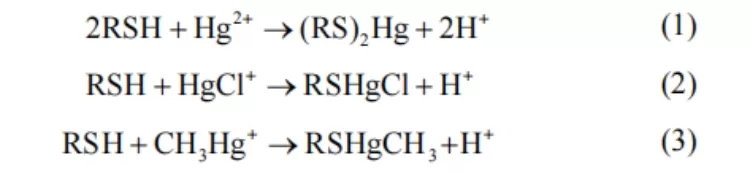
When mercury-containing wastewater passes through the resin bed, the functional groups coordinate with mercury ions and selectively bind them within the resin structure. The sulfur donor groups show particularly strong affinity toward mercury, allowing the resin to capture very low concentrations of mercury even in the presence of common coexisting ions.
This mechanism differs from non-selective physical adsorption. The resin is designed to target mercury through chemical coordination, which supports both higher selectivity and deeper removal.
The macroporous structure provides accessible internal channels for mass transfer, allowing mercury species to reach the functional sites throughout the resin bead. At the same time, the polymer matrix provides the mechanical strength required for repeated adsorption, regeneration, and hydraulic operation.
The resin is primarily applied for the removal of ionic mercury and can also treat appropriately conditioned wastewater containing complexed mercury species. Proper pretreatment and feed characterization remain important to ensure that the mercury is present in a form that can be effectively captured.
High Selectivity in Complex PVC Wastewater
PVC wastewater may contain sodium, calcium, magnesium, iron, copper, and other dissolved ions at concentrations much higher than that of mercury. A non-selective adsorbent may quickly lose effective capacity because these common ions occupy adsorption sites intended for the target contaminant.
SEPLITE® LSC740 Chelating Resin is designed to maintain strong affinity for mercury in complex multicomponent systems. Common coexisting ions have a much lower tendency to occupy the mercury-selective functional sites, allowing the resin to preserve effective capacity for the target contaminant.
This selectivity is particularly important in high-salinity PVC wastewater, where mercury may be present only at trace concentrations while the background ionic concentration is much higher.
By reducing competitive adsorption, SEPLITE® LSC740 Chelating Resin supports more stable breakthrough behavior and more predictable operating cycles than broadly adsorptive media.
Deep Mercury Removal for Stringent Discharge Targets
The main role of the chelating resin unit is to provide deep polishing after conventional pretreatment.
Sulfide precipitation and filtration can remove the majority of the mercury load, while the resin captures the residual trace mercury that remains difficult to remove using precipitation or physical adsorption alone.
This staged treatment strategy allows each technology to operate where it is most effective. Conventional processes handle the bulk contaminant load, while SEPLITE® LSC740 Chelating Resin provides the final precision required for stable discharge compliance.
With appropriate pretreatment, resin selection, bed design, and operating conditions, the process can reduce mercury to extremely low levels and provide an engineering pathway toward near-nondetectable discharge targets.
Broad Operating Range and Stable Performance
Industrial PVC wastewater is not always stable. Changes in production conditions can cause variations in flow rate, mercury concentration, salinity, pH, and the composition of coexisting contaminants.
SEPLITE® LSC740 Chelating Resin is designed for stable use across a very broad pH range. The resin matrix can tolerate strongly acidic and strongly alkaline conditions, with material stability across pH 0–14, reducing the need for extensive pH adjustment in many applications.
The resin can also accommodate variations in mercury loading and feed conditions. Its high affinity for mercury and strong mechanical structure help maintain treatment performance during temporary contaminant fluctuations or hydraulic changes.
This operating flexibility is valuable for PVC plants where wastewater quality may vary with production load, upstream treatment efficiency, or maintenance conditions.
Regeneration and Lifecycle Cost Control
Unlike disposable adsorbents, SEPLITE® LSC740 Chelating Resin can be regenerated and reused under suitable process conditions.
After the resin reaches its designated operating capacity, mercury can be desorbed using an appropriate regeneration solution, such as a hydrochloric-acid-based reagent system developed for the specific wastewater chemistry. The regenerated resin can then be rinsed and returned to service.
Regeneration reduces the volume of solid waste generated compared with single-use adsorption media and allows the mercury to be concentrated into a smaller liquid stream for controlled treatment or recovery.
Because the resin has a high mercury adsorption capacity and can operate through repeated cycles, the long-term cost per unit of treated water can remain competitive. Resin consumption, regeneration chemical demand, equipment downtime, and disposal costs can all be controlled through optimized process design.
Flexible Integration with Existing Treatment Processes
SEPLITE® LSC740 Chelating Resin can be integrated into both new wastewater treatment systems and existing PVC plant treatment lines.
A common process configuration includes sulfide precipitation for bulk mercury removal, solid-liquid separation, activated carbon or fine filtration, and a final chelating resin polishing unit. This gradient treatment route protects the resin from excessive mercury loading and suspended solids while allowing the resin to focus on trace-level removal.
For continuous operation, the resin system can be configured with two or more columns in series. The first column removes most of the remaining mercury, while the second column functions as a polishing and safety barrier.
Effluent from the downstream column is monitored to detect early breakthrough. When the lead column approaches its operating limit, the system can be switched so that the polishing column becomes the primary treatment column while the saturated resin is regenerated or replaced.
This lead-lag configuration supports uninterrupted operation and reduces the risk of mercury breakthrough into the final effluent.
Sunresin can also provide modular equipment and automated control systems to manage valve switching, flow control, pressure monitoring, regeneration, rinsing, and alarm functions. The result is a process that is easier to operate and more stable under industrial conditions.
Representative PVC Wastewater Treatment Case
At a chlor-alkali and PVC production facility, mercury-containing wastewater was treated using a combined process of sulfide precipitation, activated carbon filtration, and SEPLITE® LSC740 Chelating Resin.
The treatment system was designed for a flow rate of 4 cubic meters per hour and operated continuously for 24 hours per day. Following sulfide precipitation and activated carbon filtration, the mercury concentration entering the resin polishing stage was approximately 50 ppb.
The project required final effluent mercury to be reduced to below 0.1 ppb, a target substantially more stringent than conventional discharge requirements.
After the pretreated wastewater passed through the SEPLITE® LSC740 Chelating Resin system, the treated effluent met the required discharge specification. The resin unit provided stable deep polishing under continuous operation and received positive feedback from both the engineering contractor and the end user.
The project demonstrated that the combination of conventional bulk removal and selective resin polishing can provide a practical route for treating trace mercury in complex PVC wastewater.
It also established a reference for the application of chelating resin technology in the deep treatment of mercury-bearing wastewater from the PVC industry.
Integrated Materials, Process, Equipment and Technical Support
For deep mercury removal, resin performance alone does not determine the final result. Upstream treatment efficiency, mercury speciation, suspended solids, flow rate, bed height, contact time, breakthrough control, regeneration strategy, and automation all influence system performance.
Sunresin therefore provides more than a resin product.
Based on wastewater analysis and customer requirements, the Sunresin technical team can support process evaluation, laboratory testing, resin selection, column sizing, system design, equipment manufacturing, installation, commissioning, and operator training.
During system start-up, Sunresin application engineers can assist with resin loading, pretreatment, hydraulic testing, operating-parameter adjustment, and performance verification. After commissioning, the technical team can continue to support breakthrough analysis, regeneration optimization, and troubleshooting.
This integrated “material + process + equipment + service” approach helps reduce implementation risk and ensures that the resin and equipment are matched to the actual site conditions.
Supporting Safer and More Sustainable PVC Production
Mercury control remains an important issue for carbide-route PVC production. Traditional treatment processes are effective for reducing the bulk mercury load, but they may not consistently achieve the very low residual concentrations required by increasingly stringent environmental standards.
SEPLITE® LSC740 Chelating Resin provides a selective and regenerable polishing technology for the final stage of treatment.
Its strong affinity for mercury, resistance to common competing ions, broad pH tolerance, high adsorption capacity, and compatibility with automated multi-column systems make it suitable for complex PVC wastewater applications.
By integrating SEPLITE® LSC740 Chelating Resin with appropriate pretreatment and process control, Sunresin helps PVC manufacturers achieve stable mercury compliance while reducing secondary waste, improving operational reliability, and controlling lifecycle cost.
The objective is not simply to remove mercury from wastewater. It is to provide a practical and sustainable treatment process that protects the environment, supports continuous plant operation, and helps PVC producers meet increasingly demanding discharge requirements.
Free Quote
Resources
Adsorbent Resin
Bio-Pharmaceutical & Life Science
Enzyme Carriers
Hydrometallurgy & Mining
Chelating Resin
Chemical Industry
Chromatographic Media
Wastewater Treatment&Reuse
Food & Beverage Industries
Ion Exchange Resin
Civil & Industry Water Treatment
Equipments And Projects
Plant Extraction
Catalyst Resin
Solid Phase Peptide Synthesis
Product
Application
Contact Us
Sunresin Park,No.135, jinye Road, Xi’an Hi-tech Industrial Development Zone, Shaanxi-710076, China
seplite@sunresin.com
seplite_europe@sunresin.com
+86-29-89182091
Our Product List

Amino Acid Separation and Purification

Mobile Sorption Module for Gold Extraction

PFAS Removal

Bio-Pharmaceutical & Life Science
Modern biopharmaceutical technologies typically use biological microbial fermentation...

Chemical Industry
Purification of chemical compounds has become a vital part of most industrial processes.

Drinking Water Treatment
Drinking water is essential to life. Every day every human being has to drink and use water for food preparation.

Food & Beverage Industries
Food is closely related to everyone, and the finishing of food comes from people's relentless pursuit...

Hydrometallurgy & Mining
Hydrometallurgy is a technique for extractive metallugry involving the three general area...

Direct Lithium Extraction (DLE)
Sunresin is the major DLE lithium sorbent producer in China which mainly used for extraction lithium from salar brine and geothermal brine etc with high efficiency.

Industry Water Treatment
There are many uses of water in industry and, in most cases, the used water also needs treatment to render...

Plant Extraction
Plant Extraction is a process to gather the trace bioactive compounds from the tissue of a plant.

VOCs Treatment
With the widespread use of chemical products in the industry, more and more organic...

Wastewater Treatment
Wastewater treatment is the process of converting wastewater into an effluent that can be discharged
Latest News
15
2026 07
Sunresin Nuclear-Grade Ion Exchange Resin Passes Product Appraisal, Supporting Reliable Nuclear Power Water Chemistry Control
Sunresin has successfully passed the product appraisal for its domestically developed nuclear-grade ion exchange resin, marking an important milestone in the development of high-performance chemical materials for nuclear power applications.
14
2026 07
Sunresin and ChromaGenix Partner to Expand Global Access to AAV Purification Technologies
The cooperation is designed to expand access to advanced AAV purification technologies and provide stronger regional support for cell and gene therapy developers across Asia, Europe and the Americas.
26
2026 05
Sunresin Completes Strategic Investment in FENGXINZE to Further Expand Industrial Chromatography Business
Sunresin recently completed a strategic investment in FENGXINZE, further expanding its business footprint in industrial chromatography and strengthening its presence in the life science separation and purification sector.
Leave a Message
Please send any questions you want to know, we will reply to you immediately.
Choose File
Submit