





Sunresin’s Ion Exchange Technology Achieves Deep Mercury Removal in the Chlor-Alkali Industry
Background: Mercury Contamination Challenges in the Chlor-Alkali Industry
The chlor-alkali industry, a cornerstone of the global chemical sector, faces long-standing environmental challenges related to mercury contamination. Traditional mercury-based electrolytic processes generate wastewater streams containing mercury in various ionic and complex forms. As global environmental regulations become increasingly stringent under international mercury-control frameworks, industries are required to adopt effective technologies capable of achieving ultra-low mercury discharge levels and ensuring long-term operational stability.
Mercury-containing wastewater treatment has therefore become a critical focus for environmental management, requiring advanced purification technologies that are both efficient and compatible with continuous industrial operation. Among the available methods, ion exchange technology has emerged as one of the most robust and reliable approaches for deep mercury removal.
Ion Exchange Technology: Principle and Technical Advantages
Ion exchange is a process in which mercury ions in wastewater are exchanged with functional groups immobilized on solid polymeric ion exchange resins. These resins are insoluble, porous, cross-linked polymers designed to selectively capture specific ionic species.
For mercury removal, various resin types may be used—cation exchange, anion exchange, humic-acid-type resins, and especially chelating or macroporous specialty resins. Macroporous ion exchange resins offer significant benefits due to their high surface area and accessibility of functional groups, enabling efficient capture of mercury ions even at low concentrations.
Once adsorbed, mercury can be desorbed during regeneration, allowing the resin to be reused. Ion exchange systems operate most effectively when wastewater pH is adjusted to enhance mercury binding efficiency.
Key Advantages of Ion Exchange for Mercury Removal
1, Ultra-low mercury removal capability
When used as a secondary polishing step after physicochemical treatment, ion exchange can reduce mercury concentrations to below 5 μg/L, meeting stringent discharge standards. Systems can operate in a closed-loop mode, continuously and reliably.
2, High-quality effluent
Ion exchange resins also provide a noticeable decolorization effect. Treated water is clear and transparent, with high stability.
3, Regenerable and reusable media
Saturated resins can be regenerated and reused, reducing operating costs and minimizing waste generation.
4, Mature, easy-to-operate process
The ion exchange process is well established, operationally simple, and characterized by short flowsheets suitable for industrial deployment.
Factors Influencing Mercury Removal Efficiency
Several operational factors affect the performance of ion exchange systems for mercury-containing wastewater:
Suspended Solids & Organic Colloids
These materials may clog resin pores and reduce exchange capacity. Therefore, pre-filtration is typically required before wastewater enters the ion exchange column.
Mercury Ion Concentration
High concentrations of mercury may require pre-treatment such as precipitation or coagulation. Ion exchange then serves as a polishing step to achieve ultra-low discharge levels.
Resin Type & Selectivity
For optimal performance, the resin must exhibit high affinity and selectivity toward mercury ions. Specialized resins such as Sunresin’s Seplite® LSC740 series are engineered to ensure strong mercury binding capacity and high durability under industrial conditions.
pH, Temperature, and Flow Rate
These parameters influence ion exchange kinetics and equilibrium. Proper system design and process control are essential for stable and reproducible effluent quality.
Sunresin Seplite® LSC740 series Resin: A High-Performance Solution for Deep Mercury Removal
Sunresin’s Seplite® LSC740 series is a specialty macroporous resin designed specifically for mercury removal in industrial wastewater. Its unique polymer structure and functional groups provide exceptionally strong affinity for mercury ions across a wide range of water chemistries.
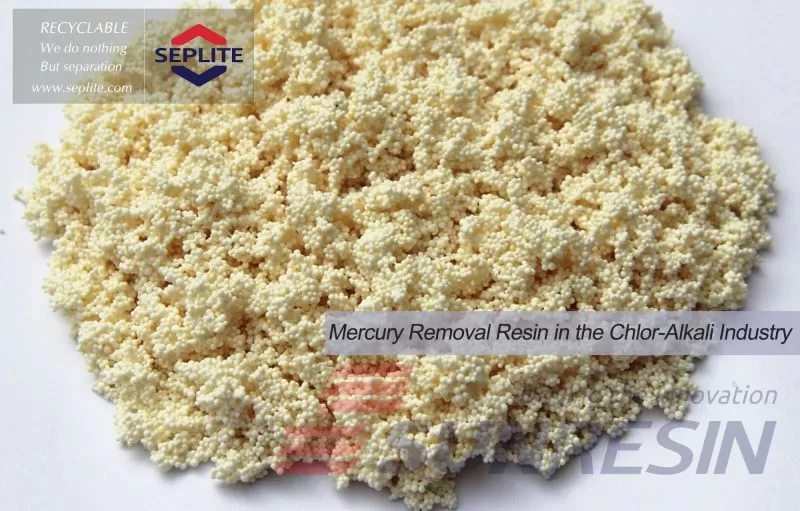
Key Performance Features
1, Extremely high adsorption capacity
The resin effectively removes ionic mercury and maintains performance regardless of mercury speciation or concentration.
2, Wide applicable concentration range
Capable of treating influent containing 0.01–5 mg/L of mercury, Seplite® LSC740 series places minimal requirements on upstream chemical precipitation processes.
3, Outstanding pH tolerance (0–14)
The resin operates effectively across the full pH spectrum, offering unmatched flexibility for diverse wastewater matrices.
4, Ultra-high removal precision
Treated effluent consistently achieves ≤ 1 ppb mercury, with excellent reproducibility during regulatory compliance testing.
5, Stable, continuous operation
The resin performs reliably under 24-hour continuous operation, making it suitable for large-scale industrial systems.
Case Study: Deep Mercury Removal in a Chlor-Alkali PVC Production Facility
A major chlor-alkali PVC manufacturer implemented Sunresin’s Seplite® LSC740 series system to treat mercury-containing wastewater generated during PVC production. The project involved:
- Flow rate: 6 tons per hour
- Operation mode: 24/7 continuous operation
- Process: Upstream chemical treatment followed by ion exchange polishing with Seplite® LSC740 series resin
Results
After deployment of Sunresin’s Seplite® LSC740 series deep mercury removal system:
- Effluent mercury levels were reduced consistently and stably to below regulatory requirements, achieving ≤ 1 ppb.
- The system demonstrated excellent operational robustness with no performance degradation over extended operation.
- The high stability and reproducibility of water quality earned strong recognition from the end-user.
This installation has since become a benchmark reference within the PVC and chlor-alkali industry for advanced mercury removal and environmental compliance.
Conclusion
Sunresin’s Seplite® LSC740 series ion exchange solution addresses the critical challenge of deep mercury removal in mercury-related industrial processes. With its strong selectivity, high capacity, broad operating window, and proven industrial performance, Seplite® LSC740 series is setting a new standard for mercury pollution control.
As environmental regulations continue to tighten globally, Sunresin remains committed to supporting industries with sustainable, high-efficiency purification technologies that protect both operational continuity and the environment.
Free Quote
Resources
Adsorbent Resin
Bio-Pharmaceutical & Life Science
Enzyme Carriers
Hydrometallurgy & Mining
Chelating Resin
Chemical Industry
Chromatographic Media
Wastewater Treatment&Reuse
Food & Beverage Industries
Ion Exchange Resin
Civil & Industry Water Treatment
Equipments And Projects
Plant Extraction
Catalyst Resin
Solid Phase Peptide Synthesis
Product
Application
Contact Us
Sunresin Park,No.135, jinye Road, Xi’an Hi-tech Industrial Development Zone, Shaanxi-710076, China
seplite@sunresin.com
seplite_europe@sunresin.com
+86-29-89182091
Our Product List

Mobile Sorption Module for Gold Extraction

PFAS Removal

Bio-Pharmaceutical & Life Science
Modern biopharmaceutical technologies typically use biological microbial fermentation...

Chemical Industry
Purification of chemical compounds has become a vital part of most industrial processes.

Drinking Water Treatment
Drinking water is essential to life. Every day every human being has to drink and use water for food preparation.

Food & Beverage Industries
Food is closely related to everyone, and the finishing of food comes from people's relentless pursuit...

Hydrometallurgy & Mining
Hydrometallurgy is a technique for extractive metallugry involving the three general area...

Direct Lithium Extraction (DLE)
Sunresin is the major DLE lithium sorbent producer in China which mainly used for extraction lithium from salar brine and geothermal brine etc with high efficiency.

Industry Water Treatment
There are many uses of water in industry and, in most cases, the used water also needs treatment to render...

Plant Extraction
Plant Extraction is a process to gather the trace bioactive compounds from the tissue of a plant.

VOCs Treatment
With the widespread use of chemical products in the industry, more and more organic...

Wastewater Treatment
Wastewater treatment is the process of converting wastewater into an effluent that can be discharged
Latest News
19
2025 11
Leave a Message
Please send any questions you want to know, we will reply to you immediately.
Choose File
Submit